
Dear ethical founder: your values are not the problem. Your systems are.
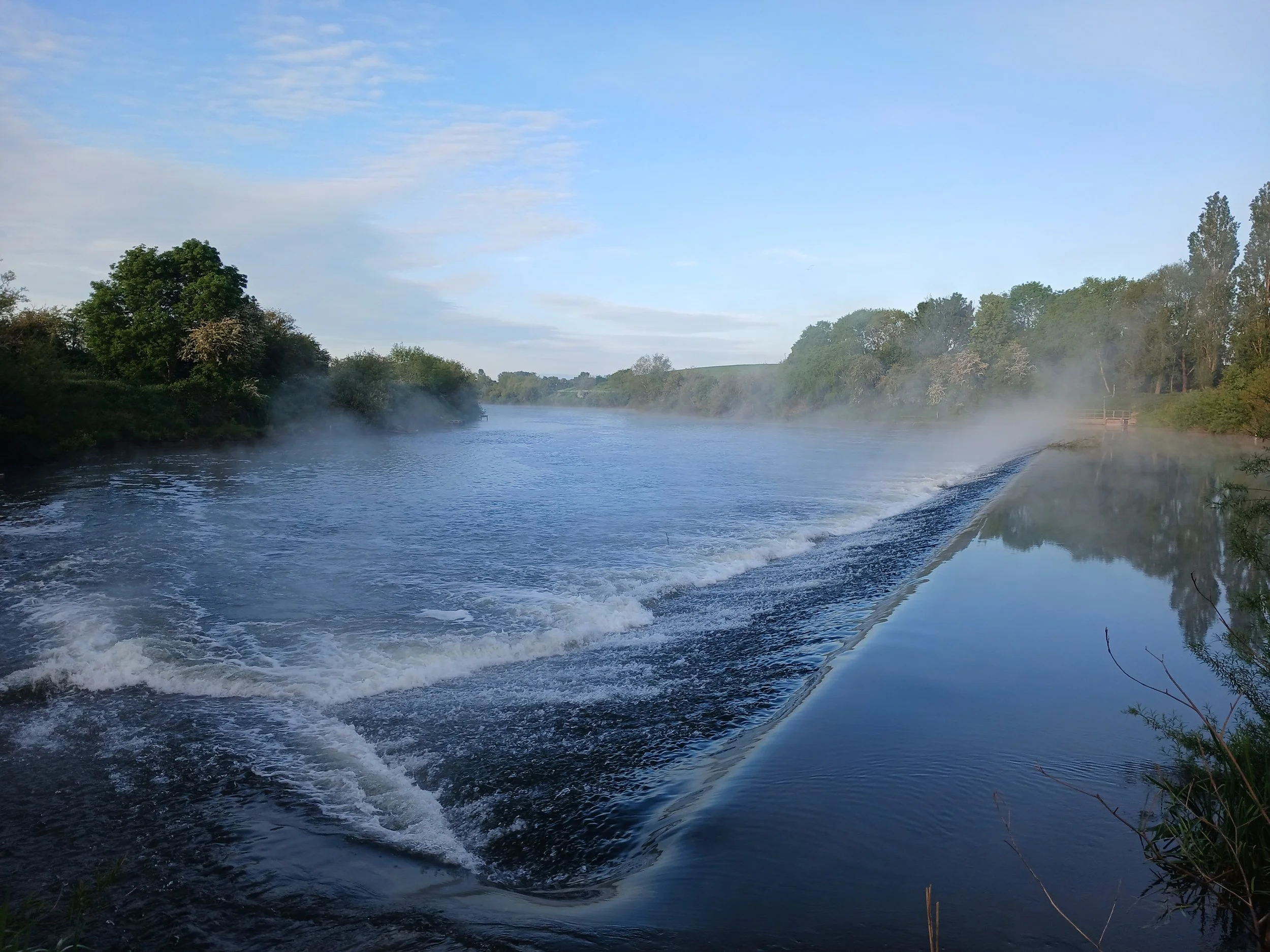
Early morning mist rising from the River Severn weir near Tewkesbury — white water spilling over the weir lip, mist drifting through the trees, soft blue dawn light
Dear ethical founder: your values are not the problem. Your systems are.
Friday, from the riverbank
I stood at the weir this morning watching the Severn do what it always does.
The mist was sitting low on the water, the way it does on early summer mornings before the world wakes up. And the river was moving, purposefully, powerfully, over the lip of the weir and downstream toward the sea. The weir doesn't stop the river. It never could. What it does is give the water structure. A place to move through. A way to direct all that force toward somewhere useful.
I've thought about that a lot in relation to the businesses I work with.
Because the river doesn't need to be told to flow. That's its nature. It just needs something to flow through.
You didn't start your business to make the world worse.
You started it because you believed there was a better way to make things. Better ingredients. Better sourcing. Better relationships with the land, with your suppliers, with your customers. You built something you're genuinely proud of. The values, your values — are the river. They're real and they're powerful and they've been flowing since the day you started.
And yet.
Some mornings it feels less like a purpose and more like a pressure. Less like flow and more like force. You're working harder than you ever imagined and the gap between what you set out to do and how it actually feels is growing.
Here's what I've noticed after 25 years in business improvement and what I see now, working with ethical product founders specifically: the problem is almost never the values. The values are solid. The problem is that the values haven't been translated into systems. There's no weir. And without that structure, even the most powerful, purposeful river loses its way — flooding the banks instead of carving a clear path forward.
These are the signs I see most often. Read through them honestly. See how many feel familiar.
1. You are the quality system
When you started, you knew exactly what went into every product. You sourced it, you checked it, you cared about every batch. Now you have a team and you still can't fully let go, because the only way to guarantee the standard is to be involved in everything yourself.
This isn't a people problem. It's a systems problem. When your values live in your head rather than in documented processes, you can't scale without losing them.
The sign: you're a bottleneck in your own business.
2. Your ethics are in your marketing, not your operations
You talk about ethical sourcing, fair pay, and environmental responsibility. You mean every word of it. But if someone asked you to prove it, in a supplier audit, a SEDEX submission, a buyer's questionnaire, you'd be scrambling.
The values are real. The paper trail isn't.
The sign: you know what you stand for, but you can't demonstrate it.
3. New starters don't learn your values, they learn your workarounds
How do new team members learn what makes your business different? Not from your website. Not from a conversation about mission. They learn from whoever trains them, and that person teaches them what they do, not necessarily why you do it.
Over time, your values dilute, not through any bad intention. Just through the absence of a system that carries them.
The sign: the culture in year one felt different from the culture now.
4. You feel guilty about profit
You got into this because you cared. Caring and profit feel like they belong to different worlds, the warm world you wanted to build, and the cold world you were trying to leave behind.
So you under-price, you overdeliver, you apologise for asking to be paid what you're worth. And the business slowly runs out of the money it needs to keep doing the good work.
The sign: you hesitate before every price increase, even when you know it's necessary.
5. You have a theory of change but not a plan
You know what impact you want to have. You can describe it beautifully,b ut between that vision and today's to-do list, there's a gap you've never quite managed to bridge.
Strategic clarity without operational structure is inspiration without traction. It feels like running in sand.
The sign: you're always busy, but not always sure you're moving in the right direction.
6. Scaling feels dangerous
Growth is supposed to be the goal. But every time you think about growing, more products, more staff, more orders, something tightens. Because you've seen what happens when ethical businesses scale without the right foundations. The corners get cut. The suppliers change. The thing that made it special gets lost.
So you hold back. Not because you don't want to grow. Because you don't trust that growth won't break what you've built.
The sign: opportunity feels more like a threat than an invitation.
7. Your certifications and your reality don't quite match
You're SEDEX registered, maybe Leaping Bunny certified, maybe Soil Association. These things matter to you and you earned them, you believe in what they stand for. But if an auditor arrived tomorrow and looked closely, there are areas where the documentation doesn't reflect the reality. Or the reality doesn't fully reflect the intention.
Not because you're dishonest. Because the systems to keep everything aligned haven't been built yet.
The sign: audits feel stressful rather than straightforward.
8. You're exhausted by decisions that shouldn't need you
What goes in this batch if the supplier is out of stock? How do we handle a customer complaint about this? What's the process when something fails a quality check?
These questions come to you. Every time. Because there's no documented answer anywhere, only you.
The sign: your team is capable, but they can't act without you.
9. The thing that lights you up is getting buried under the thing that drains you
You started this business because you loved making things. Or because you cared about what went into them. Or because you wanted to change something about the industry.
Now you spend most of your time on emails, firefighting, chasing payments, fixing problems that keep recurring. The thing that lit you up — the reason you started — gets a couple of hours on a good week.
The sign: you can't remember the last time work felt like the reason you got into it.
10. You know something needs to change, but you don't know what to do first
You're not complacent, you can feel the gap between how things are and how they could be. You've read the books, listened to the podcasts, made the plans. But the gap is still there.
The problem isn't knowledge. It's that you're too close to it, too tired from it, and too alone in it to see clearly which thread to pull first.
The sign: you're reading this and nodding.
What to do if you recognised yourself
The good news is that none of these signs mean something is broken. They mean something hasn't been built yet.
Your values are the river. They're real, they're powerful, and they've been there since the beginning. What's missing is the weir, the structure that gives all of that force somewhere to go. And building it, in a way that fits your values, your team, and the business you actually want to run, is entirely possible.
I've spent 25 years doing exactly this. Not in the cold, corporate, audit-driven way that strips the soul out of a business. In a way that starts with what you stand for and works outward from there, into your processes, your systems, your team, your strategy. The river stays the river. It just learns where to flow.
The first conversation is free. It's called a Golden Shadow Session — 45 minutes, just the two of us, no pitch and no agenda. We look at where the gap is. What's possible. What to build first.
If any of the ten signs above felt familiar, that conversation is for you.
Book your free Golden Shadow Session here →
Zoe Darlington is the founder of Pure Improvement, based beside the River Severn in Tewkesbury, Gloucestershire. She works with ethical product businesses, charities and social enterprises on values-led improvement — turning purpose into systems, and systems into lasting impact. She is a wild swimmer, a forager, and a BSI Lead Auditor who believes the hippy and the spreadsheet belong in the same room.
