
Hafren, the ancient feminine that cannot be destroyed
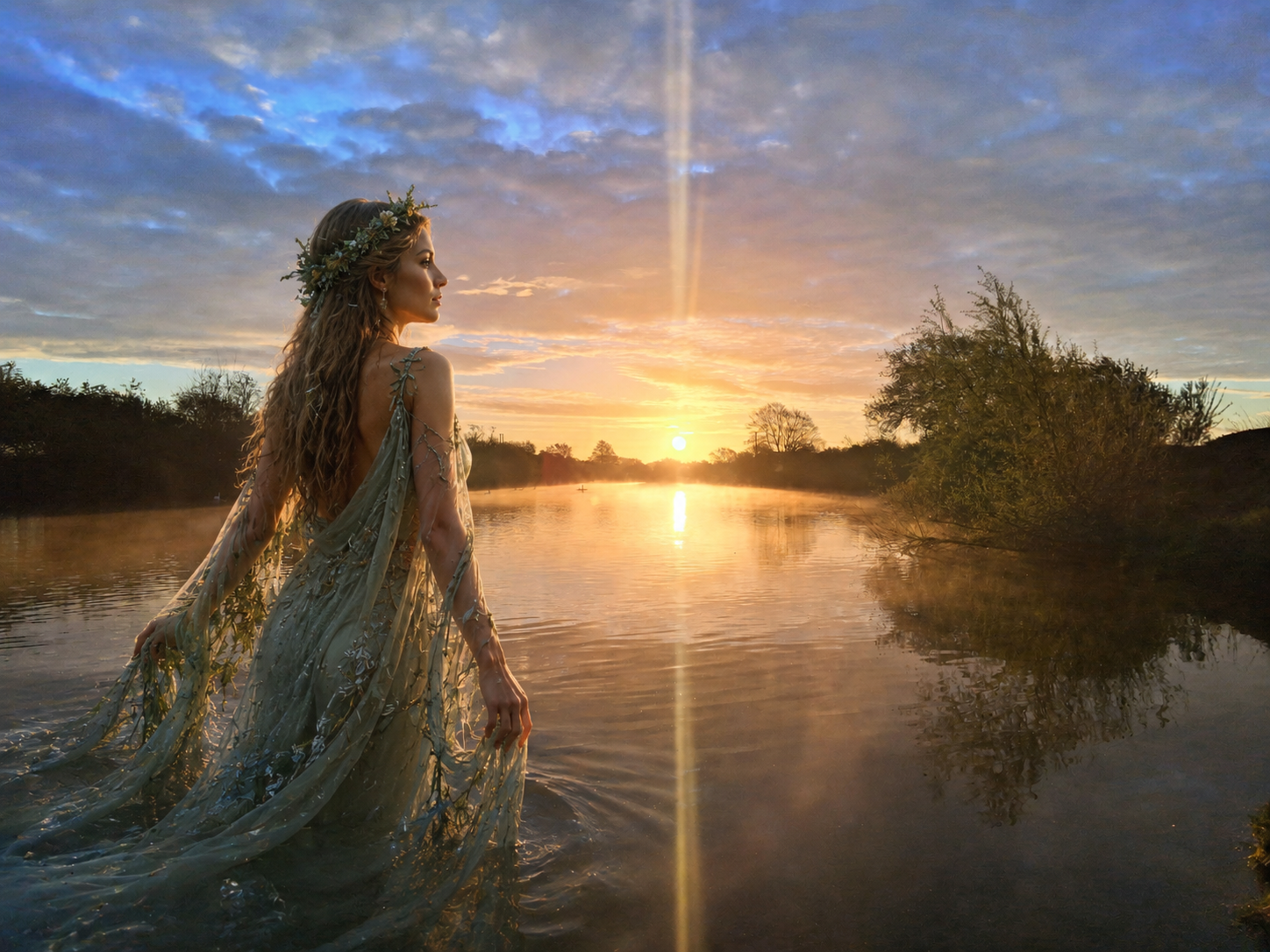
I live beside her.
Not near her, beside her, the way you live beside someone whose presence shapes the quality of every single day, whose absence you would feel somewhere deep.
The River Severn. Hafren. Sabrina. The oldest named river goddess in Britain, flowing past my door, through my town, through thirty years of my life and everything those years have held.
I have swum in her at dawn when the mist was still sitting on the water and the world had not yet started. I have walked her banks in every season and every weather and every state of mind a woman moves through over thirty years of living. I have volunteered with the Severn Rivers Trust, stood in her waters and worked for her health, given back something small of what she has always given me so freely and without condition.
And in my most broken time, when everything I thought I knew about myself needed to come apart before something truer could be built, I went to her every single day.
Not to think. Not to plan. Not to fix anything at all.
Just to be beside something that had been flowing long before my pain arrived and would keep flowing long after it passed.
She healed me. She strengthened me, fortified me, in ways I still reach for words to describe and never quite find. At times she destroyed, swept away what I was clinging to too tightly, flooded the ground I thought was solid, reminded me with her ancient unhurried force that I was not in charge of the timing, never had been. And in that destruction, as always with her, came renewal. The flood plain after the flood, the most fertile ground in the landscape, the place where everything that the water took comes back transformed.
I found this not just in a book but through sitting with her, being by her side, watching her and listening to her, connecting with her.
And I have never yet met a woman who has stood beside moving water in her most broken time and not felt something shift.
You know this feeling, I think.
Maybe it was a river, maybe it was the sea or a loch or a rain-soaked hillside or a forest after dark. Maybe it was just the moment you stopped trying to hold everything together and let something older and wiser and more patient than you take some of the weight for a while.
There is a reason we go to water when we are breaking. There is a reason it works, has always worked, will always work.
The Celtic peoples of Britain and Ireland knew it before we forgot. They knew it so completely and so naturally that it was simply the ground they stood on, the way the world was ordered, the way power actually moved through living things.
The land was feminine. The rivers were goddesses. The source was sacred and she had a name and you went to her with reverence, with offerings, with your grief and your gratitude and your most honest prayers. Not as a resource to be managed or an amenity to be maintained, but as a mother to be honoured, a presence to be known, a relationship to be tended across generations.
Hafren. Brigid. Rhiannon. Dôn. Arianrhod. The Morrigan.
The divine feminine was everywhere in the Celtic world, in the water and the fire and the earth and the turning of the seasons and the sovereignty of the land itself. A Celtic king did not own the land. He married her. His right to rule came from her blessing, and if he proved cruel or dishonest or weak she withdrew it and he fell. The feminine was not decorative or secondary or in need of protection. She was the source of all legitimate authority.
Rivers had names because they were persons. Sacred springs were holy because they were alive. The landscape was not backdrop, it was presence, it was relationship, it was the living world breathing around you and asking to be known.
And then came the waves that changed everything. Rome with its empire and its gods made in the image of power. Christianity gradually reshaping the sacred feminine into something dangerous, something to be managed, something to be saved from herself. The slow enclosure of land as property, of rivers as borders, of the living breathing world as a resource to be extracted rather than a mother to be honoured.
Each wave pushing the goddess a little further underground. Renaming her, taming her, turning her holy wells into heritage sites and her sacred rivers into county boundaries and her stories into footnotes in chronicles written by men about the deeds of men.
But she never left. She went underground, the way seeds go underground, the way rivers go underground, the way truth goes underground when the world above is not yet ready to receive it.
And the underground is not where things die. It is where things are preserved.
Hafren's own story is the proof of this.
She was a princess, daughter of Locrinus, a legendary king of Britain, and Estrildis, a woman of extraordinary beauty who had been brought to this island against her will. Locrinus loved Estrildis but had been promised in marriage to Gwendolen, daughter of a powerful king. Trapped between love and political obligation, between his heart and the agreements powerful men had made on his behalf, he made the choice that men in power so often make.
He hid them.
Estrildis and their daughter Hafren lived underground for seven years. In secret, in the dark, out of sight and out of the story, while Locrinus lived his respectable life above, his public marriage, his kingdom, his reputation all intact, the woman he loved and the daughter they had made together kept carefully invisible.
Seven years underground.
When the truth came to light it came violently, as suppressed truth so often does. Gwendolen, the wife, the wronged woman, herself a victim of the same patriarchal bargaining that had shaped all their lives, raised an army and met Locrinus in battle and won. And then, in her grief and fury, she had Estrildis and young Hafren thrown into the river.
Hafren drowned. A child, innocent of everything except being born into circumstances that were never of her making, into a story written entirely by others, into a world that had decided there was no room for her.
But the river claimed her, and the river made her immortal.
She did not disappear. She became the water, became Hafren, became the goddess of the longest river in Britain, the ancient feminine spirit that has been flowing through the heart of this land for longer than any written record can reach. She who was once held captive became the one who sets others free. Geoffrey of Monmouth wrote her story in the twelfth century and John Milton gave her voice in Comus in 1634, where Sabrina appears as a water goddess rescuing an innocent girl from captivity, the most perfect circle, the most ancient kind of justice.
She was thrown into the river and she became the river.
What looked like destruction was transformation. What looked like an ending was a beginning so vast it is still flowing two thousand years later.
She is not alone in this, Hafren. She is part of a constellation of Celtic feminine power so ancient and so deeply rooted that centuries of suppression could not extinguish it.
There is Brigid, goddess of fire and healing and poetry and the forge, so beloved and so embedded in the hearts of the people that when Christianity arrived they could not erase her, so they made her a saint instead. Her sacred flame at Kildare was tended for centuries by women alone, extinguished by a bishop because women tending sacred fire made the church uncomfortable, relit by the people, extinguished again, relit again, rekindled in 1993 by the Brigidine Sisters and burning today. You cannot put out Brigid's flame. She is the original unstoppable feminine.
There is Rhiannon, sovereign goddess on her white horse so swift no earthly rider could catch her until she chose to stop, because she chooses, she is not caught. Falsely accused of killing her own child, made to carry others on her back as punishment for a crime she did not commit, enduring it with such extraordinary quiet dignity that the truth eventually rose and she was restored. Her name means Great Queen. She was slandered and humiliated and made to carry burdens that were never hers, and she endured, and she remained herself throughout, and she was restored.
There is the Morrigan, Irish triple goddess of fate and transformation and fierce truth, appearing as crow and wolf and beautiful woman and terrible hag, not comfortable, not reassuring, showing you what is real even when you would rather not see it, destroying what needs to die so something true can be born. She is the Severn Bore made divine, that extraordinary surge of tidal water rushing inland against the natural direction of flow, Hafren reminding the world she is not tame, has never been tame, will never be tame.
There is Dôn, the great Welsh mother goddess, the source before the source, so thoroughly written out of the surviving texts by those who transcribed them that she exists mostly in glimpses and the names of the children she mothered. The original. The one from whom everything flows.
All of them hidden at some point. All of them reduced and renamed and made smaller than they were. All of them still here, still flowing, still burning, still riding.
Because the ancient feminine cannot be destroyed. It can only be driven underground for a while.
She heals, Hafren does. She strengthens and fortifies. At times she destroys, but there is always rebirth, always renewal, this is not a belief or an optimism, it is simply the law of living water.
She is pure at her source, not naive, not untouched, pure in the truest sense, clear about what she is and where she comes from even as the world she flows through becomes complicated and murky and full of the sediment of other people's choices. She does not lose herself as she moves through the world. She changes the world she moves through.
She is patient beyond any human measure. She does not hurry, is not impressed by urgency or trend or the particular anxieties of this particular century. She moves at her own pace and she has always known where she is going.
She is unstoppable, not through force but through persistence, through the simple and extraordinary commitment of water to find its way. She does not fight the obstacle, she flows around it and over time through it, small continuous movement, the river always arrives.
She nourishes without calculation, the banks and the creatures and the communities downstream and the soil and the sky, the water cycle itself, the breath of the living planet, rising and falling and rising again in the eternal movement that makes all life possible. She does not ask whether she has enough. She simply flows and the giving happens as a natural consequence of being fully what she is.
She is fierce when she needs to be and gentle when she needs to be and she has never once been asked to choose between the two.
And she returns. Always, season after season, flood after flood, drought after drought, she rises and recedes and rises again, trusting the cycle in a way that no amount of human anxiety can disturb.
Rivers are the lifeblood of this planet. Every single one of them, not just the Severn, not just the named and celebrated ones, but every river that runs through a field with no name, every underground watercourse flowing in the dark, every stream that a child crosses on stepping stones without ever wondering what it is called. They are not scenery and they are not resources. They are the circulatory system of the living earth, carrying what is needed from where it is to where it must go, nourishing everything they touch, returning always to the sea and the sky and the mountain and the sea again.
When we damage our rivers we damage ourselves. When we heal them something in us heals too.
I know this because I have been going to mine for thirty years and she has never once let me down. She is home to me. She is sanctuary. She is healer, teacher, mirror and guide. She is connection to all, to all life and to the source of everything. She is the lifeblood of this land and everything I have ever needed her to be.
We are living in a moment of remembering.
Not inventing something new, remembering something ancient, women returning to their own authority and their own wisdom and their own deep knowing, the kind that does not come from a course or a qualification but from paying attention to the living world for long enough that it starts to speak back.
The Celtic peoples knew that the source was feminine, that the river was sacred, that power flows not from dominion but from deep rooted nourishing connection to what is true. They built their understanding of sovereignty around the earth herself. The feminine was not peripheral. She was the ground everything else stood on.
That knowing went underground. Like Hafren. Like Brigid's flame. Like every woman who has ever been told she is too much or not enough or both at the same time.
But the underground is not where things die. It is where they wait.
And I keep meeting women who are ready. Who have been underground long enough. Who went to the river in their broken time and felt something ancient and patient recognise them, and who have been trying to find their way back to that recognition ever since.
Women who know their vision is real. Who know their purpose is genuine. Who know there is more, and are finally, carefully, bravely ready to let it flow.
Hafren was driven underground for seven years. She was thrown into the water by people who thought that would be the end of her.
It was the beginning.
She did not become powerful despite what happened to her. She became who she was always meant to be because of it.
The river always rises.
The ancient feminine cannot be destroyed.
And you, with your underground years and your broken time and your quietly tended vision and your deep unshakeable knowing that there is more, you were never diminished by any of it.
You were being purified.
The source is still clean.
The river is still flowing.
And it has been waiting for you.
I built Pure Collective in Hafren's image, for women who are ready to stop surviving and start flowing. If something in these words stirred something in you, I would love you to come and find out more.
The door is open.
Come to the river.
